-

Understanding Behaviour at Work: Emotional Intelligence, Leadership & Conflict Management
Understand emotional intelligence, leadership, facilitation & group dynamics in this eLearning course
Book now
27 April 2026
How to Handle Conflict at Work Without Making It Worse
To celebrate the release of our new course on understanding behaviour at work, we have below explored ways in which we can confidently handle conflict in the workplace.
It would be easy to see conflict as a sign that something has gone wrong at work. But in reality, a complete absence of tension is unrealistic in any working environment, particularly in creative, cultural and heritage settings, where people often juggle pressure, deadlines, limited resources, strong opinions and a genuine passion for the work.
According to a 2025 report by Acas, 49% of people working in arts, entertainment and recreation said they had experienced conflict at work in the last 12 months. Although it’s a high figure, it’s not necessarily surprising, as conflict is a natural part of working with other people. The more important thing is how we deal with it.
A lot of the time, conflict becomes more difficult not because of the issue itself, but because of the speed and instinct with which we react to it. If someone’s tone surprises us or a colleague challenges something we have done, or fails to do something we expected of them, our instinct may be to move quickly into defensiveness or frustration. Whilst that’s a natural human response, it is not always the most helpful.
If the aim is to handle conflict without making it worse, the best first step is usually not to solve it immediately. It is to slow yourself down enough to choose a response, rather than simply acting on whatever feels strongest in the moment.
1. Resist the urge to react immediately
A lot of conflict escalates because people respond while their emotions are high. That might look like sending a pointed email, becoming abruptly cold, over-explaining, snapping, or trying to shut the conversation down before it has properly begun. This might feel like dealing with the situation, but it’s actually just releasing tension.
A better starting point is to ask yourself what is really happening, and why your reaction to it is so strong. That small pause can make a surprising difference, because it gives you a chance to separate the issue itself from your immediate emotional reaction to it.
This is where emotional intelligence really comes in, helping us notice what we are feeling before it starts to shape how we respond. You may still need to address the issue directly, but you are much more likely to do that well if you are not responding from the height of your emotions.
2. Do not assume you know what the other person meant
One of the quickest ways to make conflict worse is to become certain too early. It’s all too easy to hear a comment and decide it was dismissive, or read an email and assume it was deliberately rude. We might tell ourselves a colleague is being difficult, controlling, passive aggressive, careless, or undermining. More often than not, we are responding not just to what happened, but to the meaning we have attached to it.
This is where the idea of mentalisation can be really useful. This essentially means remembering that other people have their own thoughts, pressures, intentions and blind spots, and that these may be different from the ones we are imagining. We tend to find this harder to do during moments of conflict.
That doesn’t mean giving everyone the benefit of the doubt indefinitely or pretending that poor behaviour is fine, but it does mean leaving some room for the possibility that our interpretation is not the whole story. Trying to empathise with the other person and considering what else might be going on can stop us from making a snap judgement.
3. Focus on the response that fits the situation
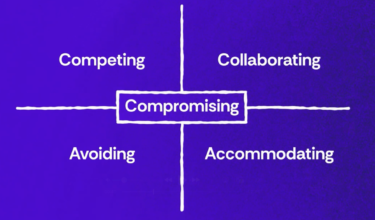
Not every conflict needs the same approach, and this is where the Thomas-Kilmann model is helpful. It sets out a range of common conflict responses: avoiding, accommodating, competing, compromising and collaborating. The value of the model is not that it tells us one of these is always right, but that it reminds us there are different ways of responding, and that some will be more useful than others depending on the situation.
[add still of model?]
- There are times when stepping back briefly is sensible.
- There are times when compromise is enough.
- There are times when a more assertive response is necessary, especially if something important is at stake or a boundary needs to be made clear.
- There are times when the best route is to stay with the discomfort for long enough to properly understand what is sitting underneath the disagreement.
It’s important not to always choose the “nicest” or most familiar option, but the one that’s most appropriate for each individual situation and the outcome you are hoping for.
4. Get clearer on what the conflict is actually about
A surprising amount of workplace conflict is not really about the thing people first say it is about. Whilst people may claim something is only about a meeting, message, decision or missed task, digging a bit deeper might reveal that it’s ultimately about unclear expectations, differences in working style, competing pressures, a lack of recognition, or frustration that has been quietly building for some time.
Before you respond, it can help to ask:
- What is the actual issue here?
- Is this a one-off problem, or part of a pattern?
- What outcome am I hoping for?
- Does this need a conversation, a boundary, a clarification, or just some time to cool down?
Those questions sound basic, but they can stop you tackling the wrong problem, and help to improve the overall situation.
5. Remember that conflict is not always destructive
Yes, conflict is uncomfortable, but that doesn’t automatically make it unhelpful. In fact, it can sometimes be the point at which something important finally becomes visible. It can reveal a tension in responsibilities, a mismatch in expectations, an inefficient style of communication, or a frustration that has been circulating for months without ever being named.
Handled badly, those things can become worse, but if handled well they can lead to clearer boundaries, better conversations and stronger working relationships. That is why conflict is not always a sign that something has gone wrong, and often it is just a sign that something needs attention.
The aim, then, isn’t necessarily to avoid conflict altogether, but to respond in a way that adds clarity rather than defensiveness or frustration.
That is easier said than done, of course, particularly when you are tired, under pressure or already carrying frustration. But it is also something people can get better at. We are not fixed in one way of handling difficult situations, and the more aware we become of our instincts, assumptions and habits, the more choice we have in how we respond.
That is exactly what we explore in our new eLearning course Understanding Behaviour at Work: Emotional Intelligence, Leadership & Conflict Management. The course looks in more depth at how conflict plays out at work, how emotional intelligence and mentalisation can help us respond more thoughtfully, and how frameworks such as the Thomas-Kilmann model can help us choose a response that is more likely to move things forward rather than make them worse. If you would like to explore these ideas in more depth, you can learn more about what’s covered in the course and how to enrol here.